
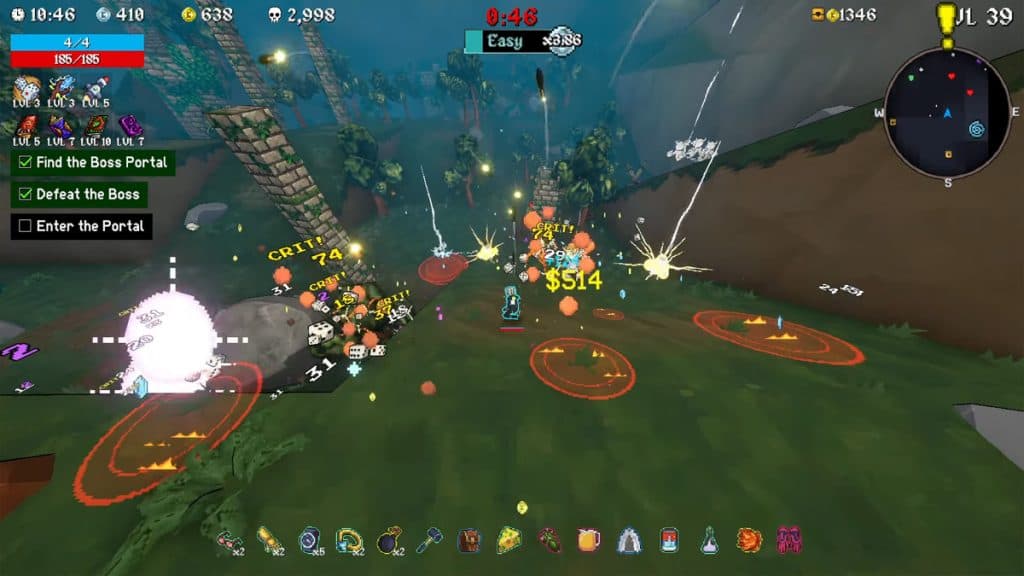
Mega Bonk, the indie roguelike has got everyone hooked. What started as a casual climb up the leaderboards turned into a grueling 14.5-hour marathon that completely redefined what I thought was possible in the game.
For over a week, the record on the current patch stood, and the journey to get there wasn’t just about skill—it was a test of mental endurance, requiring total focus for more than half a day straight.
Getting a Grip on MegaBonk’s Basics

At its heart, Mega Bonk plays by familiar roguelike rules: you bonk enemies for XP, hunt for shrines to buff your stats, and open chests for random gear. Statues give you a choice between items, which is where your build really starts to take shape.
Your character choice is huge. I went with Noel, whose passive gives you a 1% size increase per level. That might sound tiny at first, but size affects both your weapons and items, leading to exponential power growth that you’ll desperately need later on.
The weapon and tome system is deep, too. Weapons max at level 40, while tomes can go to 99, and every upgrade is unique. Whether you use common or legendary parts to level them up creates wildly different endgame builds, meaning your early luck can make or break a record attempt.
The Perfect Storm of RNG
Every single record attempt in this game starts with one make-or-break question: did you find a green credit card right away?
This one item decides if your run has record potential or if you’re resetting within minutes. Credit cards give you +2% luck per chest opened, and that bonus stacks infinitely. With 100 cards, you’re getting 200% luck from every chest. Since luck affects everything—chest loot, shrine upgrades, item quality—the scaling gets absolutely ridiculous.
My record run began with insane fortune. In the first few minutes, I found a holy book and a green credit card back-to-back. Soon after, a mirror popped up in my loot. Mirrors are essential—they reflect infinite damage, which is the only way to survive the late-game where enemies hit for billions.
Finding Kevin, a hostile NPC you can manipulate for damage boosts, plus an electric plug and golden shield created an insane combo. But the real game-changer was finding a key next to a microwave, which let me duplicate the key immediately.
Keys give you a 10% chance to open a chest for free (without raising its price). While 10 keys don’t mean 100% free chests due to probability, they let you keep opening chests long after their gold cost would have bankrupted you.
The Tier System and Strategic Patience
The game is split into tiers, each ending with a boss and then a punishing “final swarm” of ghosts. The secret to a record run isn’t just surviving—it’s extending those ghost phases as long as humanly possible.
In Tier 1, I did okay but couldn’t stretch the swarm too far. The real magic happened in Tier 2, when my luck percentage soared past 1,000%. At that point, shops start selling mostly purple items and credit cards, and chests practically rain legendaries.
Here’s where a key bit of strategy came in: the Moai Shrine, or “Big Bobby” as players call it. This shrine doesn’t generate its items until you first open it. If you open it early, you get common junk. If you wait until you have over 300% luck, it spits out legendaries. I managed to resist the temptation all through Tier 1, finally cracking them open in Tier 2 for an epic payoff.
My microwave finds in Tier 2 let me duplicate keys six more times, securing my economy. When four green credit cards dropped in a row, my luck scaling went into overdrive, and I knew the record was truly within reach.
The Difficulty Balance
One thing most players get wrong is the difficulty slider. Crank it up, and enemies spawn faster.
Sounds harder, right?
But here’s the secret: it actually helps you. More enemies mean more experience and kills, faster. T
he real trick is balancing your damage output so you can keep up. Push the difficulty too far without the damage to match, and you’re overwhelmed. Don’t push it enough, and you’re leaving kills on the table.
I walked that tightrope carefully. The golden shields I found were a lifesaver—each one multiplies your gold, letting me buy out every single chest during those long, drawn-out ghost phases. By Tier 2, I was surviving the final swarm for over four minutes longer than most runs ever could.
At that point, movement speed and jump height became just as crucial as raw damage—they kept me alive, looting chests while dodging ghost attacks that could one-shot me.
The Anvil Problem and Missing Optimization

Even with all the incredible luck, I never found one critical item: the anvil. This legendary piece gives you three stat upgrades per weapon level instead of two—a massive 50% power increase.
By the time it finally showed up, my weapons were already maxed out. It was useless. That mistake put me way behind in raw damage compared to the previous record holder, Lord DJBJ.
To compensate, I leaned hard into other combos. I stacked overpowered lamps (which make some effects trigger twice) and maxed out Joe’s Daggers.
With the right setup, I had a 30% chance to execute an enemy with every hit, each execution permanently boosting my damage by 1%. The scaling got ridiculous, but it still wasn’t the pure power of that missing anvil.
The Mental Marathon Begins
About 90 minutes into Tier 2’s endless swarm, I faced the truth: I was nearly 20,000 kills behind the record pace. To catch up, I’d have to survive this phase longer than anyone thought possible.
That’s when I perfected the “pilot tech.” By letting the ghosts nudge me against chests in just the right way, I could lock into a flight pattern that kept me safe while my character racked up kills automatically. What followed was a test of pure endurance.
For hours, I held the same directional inputs, flying in lazy circles, occasionally sniping a distant chest to break the monotony. This is where most players quit—not from dying, but from sheer boredom and mental fatigue.
Seven hours into Tier 2 alone, my sanity was fraying. Voice chats with friends turned into delirious nonsense. Hitting a chest from across the map felt like a major victory. The thought of doing this for two more tiers was daunting.
Solving the Ghost Immunity Mystery
Near disaster struck around hour three of the swarm. I lost two of my Zardos (extra lives) in 30 minutes, leaving me with just one safety net. One mistake would erase over 10 hours of progress.
This run succeeded where others failed because I solved a hidden problem: ghost immunity. Most top runs eventually hit a wall where ghosts become completely immune to damage.
Why? Through talking with the developer, I learned it was caused by execution items like Joe’s Dagger.
Against ghosts with trillions of health, these “execute” effects would bug out, making the ghosts permanently unkillable. By avoiding stacking too many of these items, my ghosts stayed vulnerable forever.
The Final Push
By Tier 3, with over 285,000 kills, I had finally pulled ahead of the old records. My power was absurd—single hits dealt billions of damage, bosses died instantly, and my character was so large the weapons covered the screen.
The strategy stayed the same: use freeze power-ups to loot safely, maintain the pilot tech, and protect my last Zardo. My luck soared past 7,000%, making every drop legendary.
The Tier 3 swarm lasted another seven hours. I watched the kill counter climb by 400+ per minute. Previous record holders quit around 600-650k kills.
We blew past 700,000 and kept going. In the end, we stopped at 1,127,000 kills not because the game beat us, but because we are human. After 14.5 total hours—over seven spent in Tier 3 alone—continuing felt less like a triumph and more like punishment.
The Technical Breakdown
After the run, I analyzed the build. I finished with 343 legendary items and 88 credit cards. But the real damage dealer wasn’t flashy. It was a common item: the cursed doll.
The cursed doll deals damage based on 30% of the enemy’s max health. Against ghosts with trillions of health, each proc hit for hundreds of billions—damage that scales infinitely, unlike flat damage boosts that eventually plateau. That, combined with avoiding the execution items that broke other runs, was the technical key to this marathon record.
It was less about being the strongest build on paper, and more about being the one that could survive—in every sense of the word—the longest.


